
Hold & Win has become one of the most recognisable and commercially successful mechanics in modern iGaming. What started as a powerful bonus format has evolved into a benchmark for engagement, retention, and performance across portfolios worldwide.
But what truly drives its dominance – and how should studios approach it in an increasingly saturated market? Let’s explore the psychology behind its appeal, its strategic value, and how the mechanic continues to evolve.
The rise of Hold & Win: from trend to industry standard
Hold & Win is a bonus feature triggered by special bonus symbols that appear during the base game. These symbols typically carry fixed cash values or may represent jackpot prizes. When a required number of such symbols land on the reels, they activate a bonus round in which these value-bearing symbols reappear as the core mechanic.
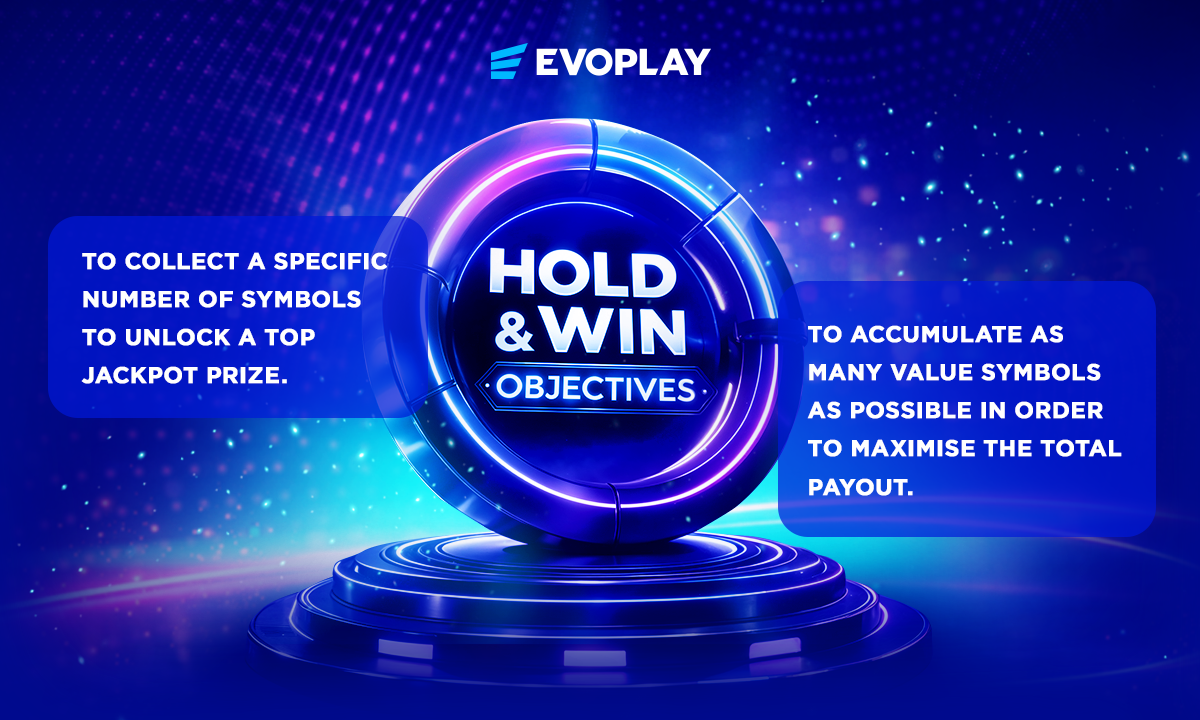
The mechanic is referred to as “Hold & Win” because, in its classic format, each symbol that lands remains locked in position on the reels for the duration of the feature. While modern variations may have symbols disappear after increasing the win amount or triggering a specific bonus mechanic, these features are considered adaptations rather than part of the traditional format.
Importantly, Hold & Win should not be viewed as a short-lived trend. The mechanic has existed for many years, long before its current surge in popularity. Although the exact origin and original creator remain unclear within the iGaming industry, the format was already present in land-based slot machines and traditional casinos more than a decade ago.
Why integrating Hold & Win was a strategic move for Evoplay
Five years ago, we set out to create our first Hold & Win game, Cycle of Luck. At that time, the classic Hold & Win mechanic was already feeling somewhat outdated, so we needed to innovate. We wanted to create something new while maintaining the core appeal of classic mechanics. The key point is that a standard Hold and Win game typically follows a 5×3 format, where bonus symbols simply land on the reels. In Cycle of Luck, however, the base game is played on a 5×4 grid, while the bonus round expands to 5×8, introducing additional rows that must be unlocked. For our first implementation of the Hold and Win mechanic, it was a fairly bold step, as we had no prior experience with this format.
At the same time, our team was working on another Hold & Win game, Gold of Sirens, which used a simpler version of the mechanic. Both games performed well, and this success encouraged us to continue refining and promoting this feature. However, around three years ago, we made a conscious decision to return to more straightforward Hold & Win formats and to focus on careful balancing to ensure a more engaging gameplay experience. This refined approach has proven effective, contributing to stronger overall performance results.
Even in modern titles, we still use the classic Hold & Win without additional symbols, boosters, or complex mechanics. The simplest form of Hold & Win is when there’s just one bonus symbol, and that’s the only symbol that lands. The simplicity of this mechanic helps maintain player engagement, as it’s easy to understand – once people experience it for the first time, they quickly grasp how it works.
The impact of this mechanic on our portfolio isn’t just about the mechanic itself; it’s the setting in which it’s applied. Hold & Win can be integrated into virtually any game, shifting the game’s mathematics while keeping it interesting. This makes the potential for larger wins more visible while ensuring the gameplay remains intuitive and accessible.
The secret behind Hold & Win’s lasting appeal
When asked, “What emotional trigger makes Hold & Win so engaging: operator push or player demand?”, the answer is clear: operators wouldn’t request mechanics that don’t have player demand. They focus solely on those things that players engage with most actively. Any request from operators ultimately stems from player behaviour, as they base their decisions on metrics that show where players are most engaged, where retention is strongest, and where gameplay thrives. Slots featuring various Hold & Win mechanics consistently top the charts, proving that this feature works exceptionally well – and has been successful for quite some time.
Hold & Win incorporates core elements that are enhanced with animations to make certain moments more compelling for the player. At its heart, however, we’re working with mechanics that focus on filling up spaces or accumulating values. Both of these elements create a sense of progress – either by filling positions or collecting sums in collector symbols. As the game progresses and spins continue, players consistently accumulate their winnings without taking any risk, further reinforcing a rewarding and engaging experience.
What defines a high-performing Hold & Win title today
I am often asked, “What does Evoplay need to do to ensure its Hold & Win titles remain relevant in such a competitive market, where new and exciting games are being introduced every day?” However, this isn’t just about Hold & Win mechanics. To succeed in today’s market, it’s essential to develop a diverse range of games, including unique mechanics and innovative versions of Hold & Win, as well as other game types. We need to offer players what they enjoy, but also avoid over-saturating the market with the same formula, as familiarity can quickly breed indifference.
When a successful game is created, it’s often followed by clones in various settings. A sound strategy, therefore, involves working intelligently, analysing data, and crafting well-balanced systems that introduce new layers of enjoyment for players. While this may sound simple, the reality is more complex because different markets have unique preferences. Consequently, one game may not have the same impact across all audiences.
Closing note: The future evolution of the mechanic
Looking ahead, it’s difficult to predict exactly what the future holds, as the evolution of the mechanic is already underway. For instance, features like 3 Pots have been added to Hold & Win, while in some cases, games are built entirely around Hold & Win, with no main game (as we imagine it) at all. Titles such as Cat’s Blessing and Imperial Relics: Three Pots are all examples of Hold & Win games, with the core mechanic enriched by additional features like 3 Pots.

In iGaming strategy, it’s common for a simple concept to scale over time with new functions added to enhance the experience. This is precisely what is happening with Hold & Win. The base mechanic will continue to evolve, with new mechanics layered on top to make the gameplay even more engaging. While the core Hold & Win will remain effective for a certain audience, more advanced versions will be developed for players who seek deeper experiences. These versions may feature multipliers, collectors, Wheel of Fortune mechanics, various boosters, and even more complex systems such as 4 Pots, 5 Pots, double- or triple-reel sets, and accumulative features.
The possibilities are limitless, and as such, it’s hard to predict what the future holds. One thing is certain: there are no real boundaries, and Evoplay is always striving to surprise and innovate with our products. Stay tuned for more exciting developments!