Have you ever dreamed of winning a big lottery jackpot? Millions have.
That dream has remained unchanged for decades – the promise of a life-changing win. It has long held strong cultural traction in the United States, where marketing helped turn the lottery into a mass culture built on aspiration and opportunity.
But in a rapidly digitalising world, a simple question emerges: does the lottery still feel relevant today? And, more importantly, can it continue to resonate with next-generation players shaped by video games, iGaming, and always-on entertainment?
To explore this shift, we spoke with Luca Esposito Poleo, Executive Director of the World Lottery Association, and Frank Cecchini, Head of Lottery at Evoplay.
The enduring power of lottery
A lottery’s key purpose has always been to generate revenue for good causes. This is often forgotten, despite a significant share of revenues going into social projects, sports, and cultural initiatives.
Looking inside, lotteries operate under different models depending on the local market and its regulations. In some jurisdictions, there is a single monopoly on all forms of gambling where lottery tickets are sold alongside casino games and sports betting. In others, lotteries only have a monopoly on lotto-style games and scratchcards (both online and offline), while some operate in competitive markets. In all cases, they function as highly regulated systems built on trust and long-term public value.
Across all these models, the foundation is the same: a significant share of revenues flows back into public value – through good causes, state budgets, or social programmes.
As Frank Cecchini explains, this is built into the product itself:
When you play the lottery, you’re not just playing for the chance to win – you’re also contributing to good causes such as funding education, the arts, and helping underprivileged people.
This is central to how lotteries position themselves. Yet the connection is not always clearly visible – especially to younger audiences, for whom the lottery often sits in the background rather than at the centre of the experience.
This gap in perception is exactly where storytelling becomes essential, as it plays a dual role for lotteries: it links participation with real-world impact and can also help them stay relevant to new audiences.
As Luca Esposito explains, drawing on discussions at the WLA/EL Marketing Seminar in Barcelona (attended by over 200 participants from more than 40 countries), lotteries widely agreed that human stories are a powerful way to strengthen emotional engagement and deepen understanding of what lotteries represent.
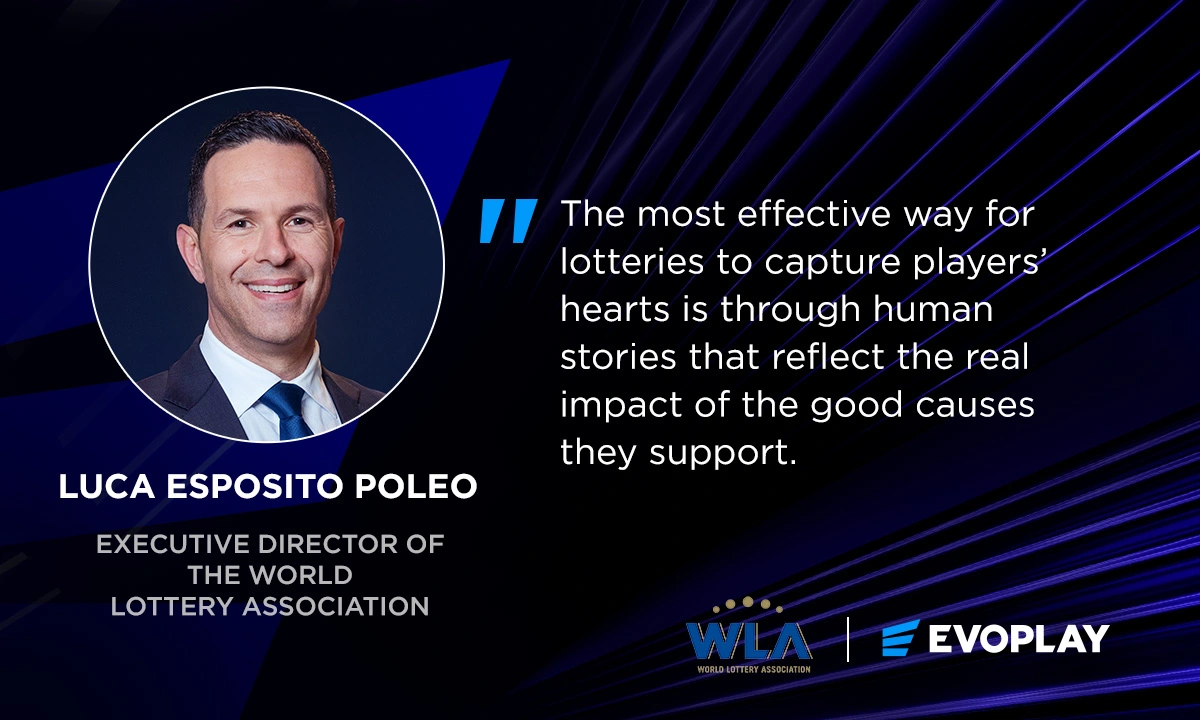
A clear insight emerges: the value of the lottery is not only in jackpots or structure, but in narrative – how its impact is communicated and understood.
As Luca Esposito notes, it takes years to build trusted, valued brands. Lotteries already benefit from this trust, but they are increasingly losing visibility in a digital entertainment landscape that evolves much faster, making them less present in the attention space of new audiences. This is why continuous innovation is becoming essential to stay relevant for next-generation players.
In turn, Frank Cecchini, Head of Lottery at iGaming provider Evoplay, works directly with online lotteries as an entertainment format to address this challenge. At Evoplay, the online lottery is being redefined through a stronger layer of entertainment, supported by innovation while preserving its core identity.
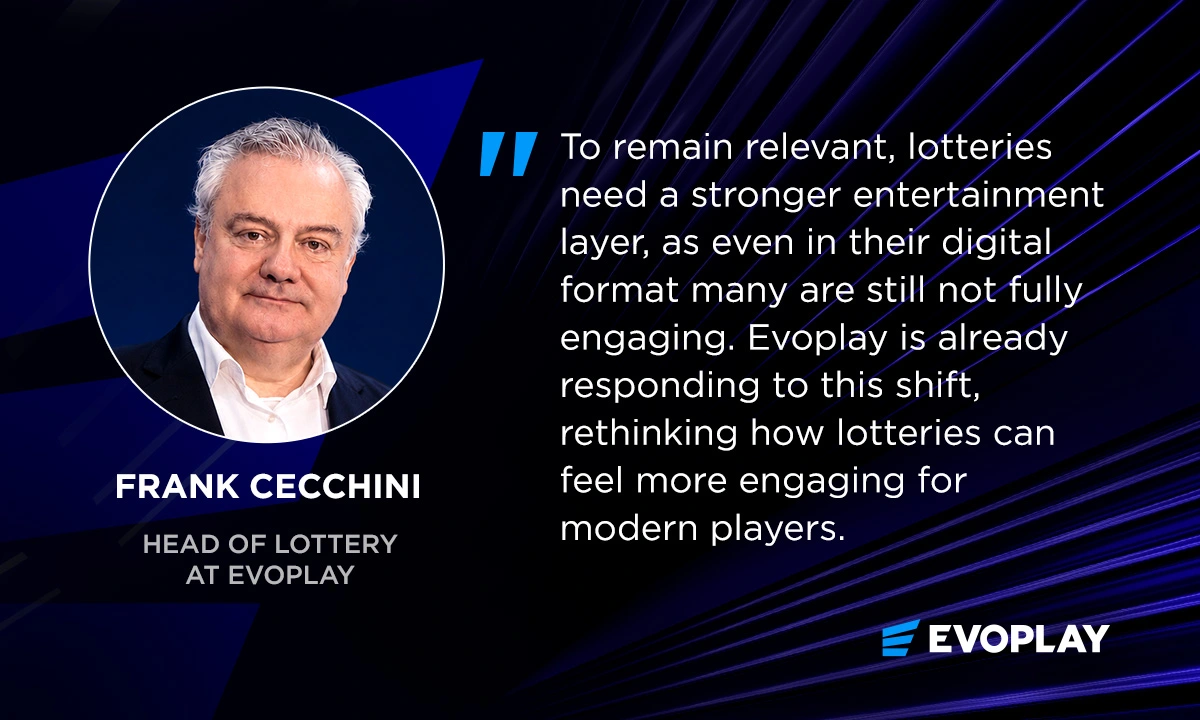
The broader story of lotteries, supported by expert insights, highlights a rare balance between chance and purpose – where entertainment meets a meaningful social dimension within a single product.
To sustain this balance, the lottery is evolving into a more engaging form of entertainment for a new generation shaped by digital-first experiences, while still operating within a regulated and responsible framework.
The future of lottery: balancing innovation, entertainment, and trust
The entertainment market is increasingly shaped by faster, more dynamic, and socially interactive experiences. Much of this is driven by younger audiences who grew up with social media, mobile gaming, betting, entertainment, and smartphones as their primary way of consuming content. Luca Esposito emphasises:
The next generation of players (Gen Z) are digital natives, which means lottery and betting operators must build effective communication with customers and deliver a seamless omnichannel experience.
Frank Cecchini continues this idea, noting that Millennials and Gen Z have already become one of the largest consumer forces in the digital era. As a result, lotteries need to strengthen the entertainment layer of their products to stay competitive with modern digital entertainment.
According to Frank Cecchini, this shift pushed Evoplay to rethink the traditional lottery format around the expectations of modern players. To make iLottery more engaging, iGaming providers such as Evoplay focused on developing modern lottery games across several directions:
- popular themes with broader audience appeal;
- storytelling and franchise-driven game development;
- modern gameplay without losing the essence of the lottery;
- improved UX/UI and smoother animation;
- localisation and personalisation.
One example of this approach can already be seen in digital lottery products such as Adrenaline Rush: Scratch, which introduce a more entertainment-driven layer while preserving the core lottery structure.
Importantly, the objective is not to turn lotteries into casino-style products. As Frank Cecchini explains:
Lotteries cannot directly compete with faster and more dynamic iGaming products. But they can still make their games more entertaining, technically advanced, and continue relying on their core value – supporting good causes.
Among possible future transformations, he also highlights depleting pool technology – a mechanic based on a pre-generated prize pool that gradually decreases as players participate. According to Frank Cecchini, this makes the experience more engaging while still preserving the responsible nature of the lottery.
Looking ahead, he also reflects on the idea of shared digital lottery tickets, where players could join together, split ticket costs, and share the experience collectively. This concept could resonate with the more social and interactive behaviour of younger generations.

At the same time, innovation is increasingly taking place within a broader technological and regulatory context that defines its practical application.
AI and the role of regulation in modern lottery
As Luca Esposito notes, discussions at the WLA/EL Marketing Seminar in Barcelona highlighted an important point: lottery innovation must evolve alongside regulation and local cultural realities.
Within this context, both Luca Esposito and Frank Cecchini see AI as a supporting tool rather than a replacement for strong, authentic products or human decision-making in operations.
Building on this broader shift in how the industry approaches innovation and communication, Luca Esposito highlights a growing emphasis on authenticity and human-led storytelling:
Increasingly tech-savvy customers can distinguish between AI-generated and authentically created storytelling.
He further points to the growing importance of regulation around influencer marketing and gambling-related advertising as part of this evolving environment:
Influencers must disclose paid partnerships and restrict content access based on age and geography.
Frank Cecchini also sees AI playing an important role in supporting responsible gaming and fraud detection, helping strengthen operational safety and compliance. From a game provider perspective, Evoplay’s Head of Lottery emphasises its role as a practical tool for personalisation and improving the player experience:
AI can help understand player behaviour, identify patterns, improve targeting, and increase relevance in line with existing regulations.
However, Frank adds that AI remains a supporting layer rather than a substitute for creative product thinking. It can improve efficiency and provide useful insights, but it can’t replace the human side of product development or the entertainment value that drives long-term engagement.
Next-gen lottery: evolving without losing its core
The future of the lottery will depend on its ability to balance innovation with trust.
While entertainment and digital experiences are becoming increasingly important for engaging younger audiences, the core value of the industry remains unchanged – supporting good causes through a regulated and responsible model.
The challenge ahead is not to transform the lottery into something else, but to evolve its game experience, storytelling, and surrounding ecosystem into a more relevant form of entertainment that still preserves its purpose.
In other words, the transformation is not only about the lottery itself, but also about how it is played, experienced, and perceived by a new generation of players.